
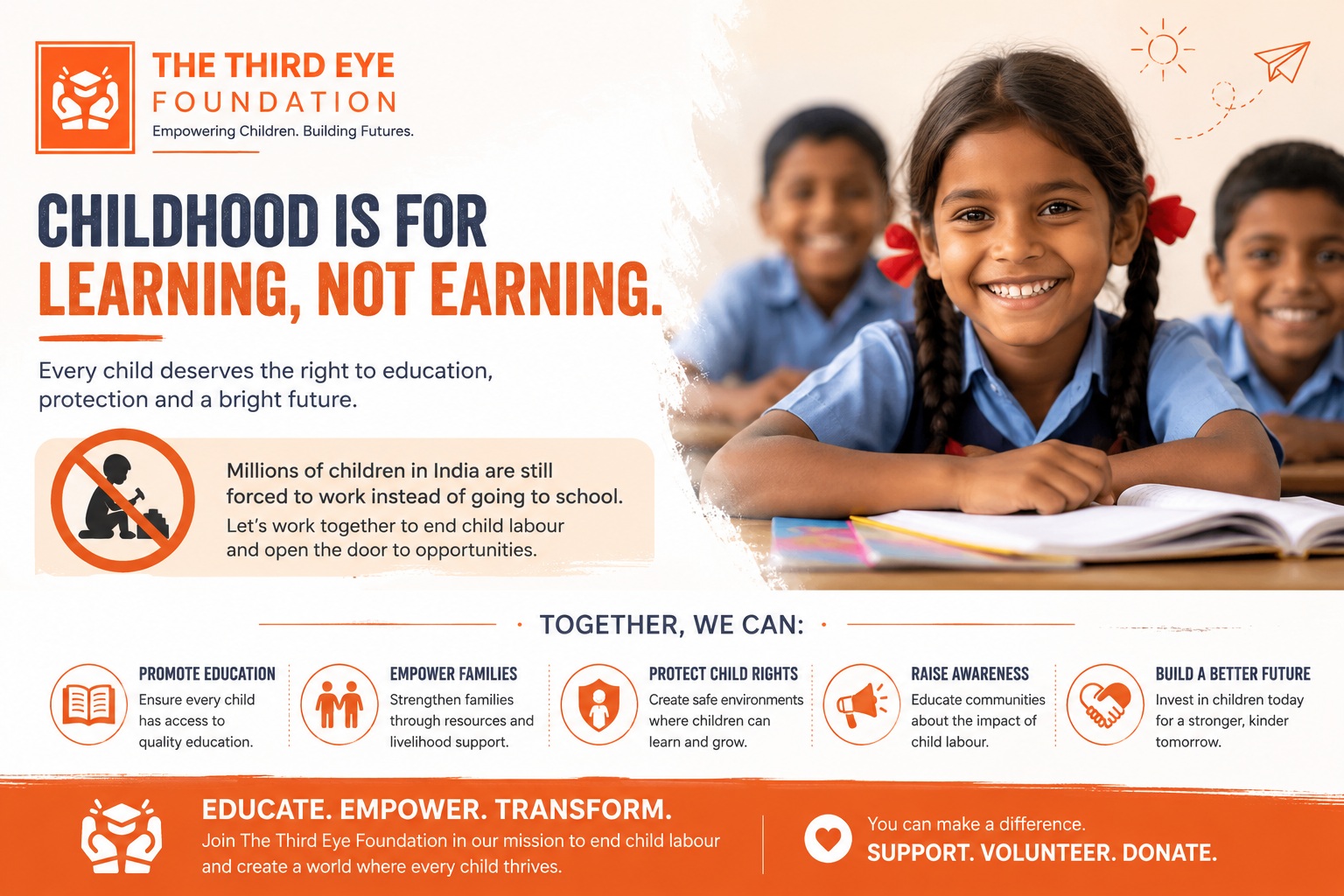

Every child deserves a childhood filled with learning, play, safety, and opportunities to dream. Yet, millions of children across India continue to spend their formative years working instead of attending school. Child labour remains one of the most pressing social challenges facing our country, preventing children from reaching their full potential and trapping families in cycles of poverty.
While India has made significant progress in reducing child labour over the past two decades, the problem has not disappeared. Many children are still found working in farms, factories, workshops, households, construction sites, roadside businesses, and other informal sectors. Behind every child labourer is a story of economic hardship, limited access to education, social inequality, or exploitation.
At The Third Eye Foundation, we believe that education is the most powerful tool to break this cycle. By supporting vulnerable families, promoting school enrollment, and creating awareness within communities, we strive to ensure that every child has the opportunity to learn, grow, and build a brighter future.
What is Child Labour?
Child labour refers to any work that deprives children of their childhood, education, health, dignity, and overall development. It includes activities that are physically dangerous, mentally stressful, emotionally harmful, or that interfere with a child's ability to attend school regularly.
According to the International Labour Organization (ILO), child labour includes work that harms children's physical and mental development or prevents them from enjoying their basic rights.
Not all work performed by children is considered child labour. Helping parents occasionally with age-appropriate household tasks or participating in supervised activities that do not affect education may not be harmful. However, when children are forced into regular employment, long working hours, hazardous conditions, or situations that keep them away from school, it becomes child labour.
Child Labour in India: The Current Situation
India has witnessed a gradual decline in child labour over the years due to stronger laws, educational initiatives, and awareness campaigns. However, millions of children remain vulnerable to exploitation.
Many children are engaged in :
Economic instability, migration, natural disasters, family debt, and lack of educational opportunities continue to push children into the workforce.
The COVID-19 pandemic further exposed vulnerable families to financial stress, increasing the risk of school dropouts and child labour in many regions.
Why Does Child Labour Continue to Exist?
1. Poverty and Financial Hardship
Poverty remains one of the leading causes of child labour. Families struggling to meet basic needs often rely on additional income from their children to survive. In many cases, children become contributors to household earnings at a very young age.
2. Limited Access to Education
Schools may be unavailable, under-resourced, or located far from rural communities. When quality education is inaccessible, families may see work as a more immediate option than schooling.
3. Lack of Awareness
Many parents are unaware of the long-term consequences of child labour. Some communities continue to view child work as a normal part of growing up rather than a violation of children's rights.
4. Social and Cultural Factors
Traditional practices, gender discrimination, and social norms can influence decisions that keep children, especially girls, out of school and engaged in labour.
5. Weak Enforcement of Laws
Although India has laws prohibiting child labour, enforcement remains challenging in remote areas and informal sectors where monitoring is difficult.
The Impact of Child Labour on Children
Loss of Education : When children work instead of attending school, they lose opportunities to develop knowledge, skills, and confidence needed for future employment and independence.
Health Risks : Many child labourers work in dangerous environments where they face exposure to chemicals, machinery, dust, extreme temperatures, and physical strain.
Emotional and Psychological Effects : Children engaged in labour often experience stress, anxiety, isolation, and emotional trauma. They miss out on normal childhood experiences that are essential for healthy development.
Increased Vulnerability : Child labour exposes children to exploitation, abuse, trafficking, and unsafe working conditions, putting their safety and well-being at risk.
How Child Labour Affects Society
The consequences of child labour extend far beyond individual children.
Slows National Development : A nation cannot achieve sustainable growth when millions of children are denied education and skill development.
Perpetuates Poverty : Children who miss education often become low-income adults, creating a cycle that continues across generations.
Reduces Workforce Productivity : Educated individuals contribute more effectively to economic growth, innovation, and social progress.
Violates Human Rights : Every child has the right to education, protection, health, and dignity. Child labour undermines these fundamental rights.
Child Labour and Gender Inequality
Girls often face a double burden. In addition to household responsibilities, many are employed as domestic workers or caregivers while being denied educational opportunities.
Promoting gender equality is essential to eliminating child labour. When girls receive quality education and support, they are more likely to become financially independent and contribute positively to their communities.
To address gender-related barriers, communities must:
Child Labour in Rural and Urban India
Rural Areas : Child labour in rural India is largely concentrated in agriculture and allied activities. Children often work in fields, tend livestock, and assist in family farming operations.
Urban Areas : In cities, children may be found working in restaurants, workshops, construction sites, roadside stalls, domestic households, and informal manufacturing units.
Although the nature of work differs, the underlying causes remain similar - poverty, limited educational opportunities, and social vulnerability.
Government Efforts to Eliminate Child Labour
India has introduced several measures to protect children and promote education:
Right to Education (RTE) Act : This legislation guarantees free and compulsory education for children between 6 and 14 years of age.
Child Labour Laws : The Child and Adolescent Labour (Prohibition and Regulation) framework prohibits employment of young children in hazardous occupations and regulates adolescent work.
National Child Labour Project (NCLP) : This initiative focuses on identifying, rehabilitating, and mainstreaming child labourers into formal education.
Social Welfare Programs : Schemes supporting employment, nutrition, healthcare, and financial inclusion help reduce economic pressures that often lead to child labour.
The Role of NGOs in Ending Child Labour
Government policies alone cannot eliminate child labour. Community-driven action is equally important.
NGOs play a critical role by :
Through grassroots engagement, NGOs help address the root causes that keep children out of school.
How The Third Eye Foundation is Making a Difference
At The Third Eye Foundation, we believe that every child deserves access to education, opportunity, and hope.
Our efforts focus on:
Promoting Education : We support initiatives that encourage school enrollment, reduce dropout rates, and provide educational opportunities for children from disadvantaged backgrounds.
Community Awareness : Through outreach programs, we educate parents and communities about the harmful effects of child labour and the long-term value of education.
Supporting Vulnerable Families : By connecting families with resources and opportunities, we help reduce economic pressures that often force children into labour.
Advocacy and Collaboration : We work alongside local stakeholders, educators, volunteers, and community leaders to create child-friendly environments where learning takes priority over labour.
What Can You Do to Help?
Ending child labour requires collective action.
You can contribute by :
Every action, no matter how small, can help transform a child's future.
Conclusion
Child labour is more than a social issue - it is a barrier to education, equality, and national progress. Every child working instead of learning represents lost potential, broken opportunities, and a future that could have been brighter.
By investing in education, empowering families, strengthening child protection systems, and creating awareness, we can build a society where no child is forced to sacrifice their childhood for survival.
The Third Eye Foundation remains committed to creating a future where every child has the opportunity to learn, grow, and achieve their dreams. Together, we can help ensure that classrooms replace workplaces and that every child receives the chance to build a better tomorrow.