
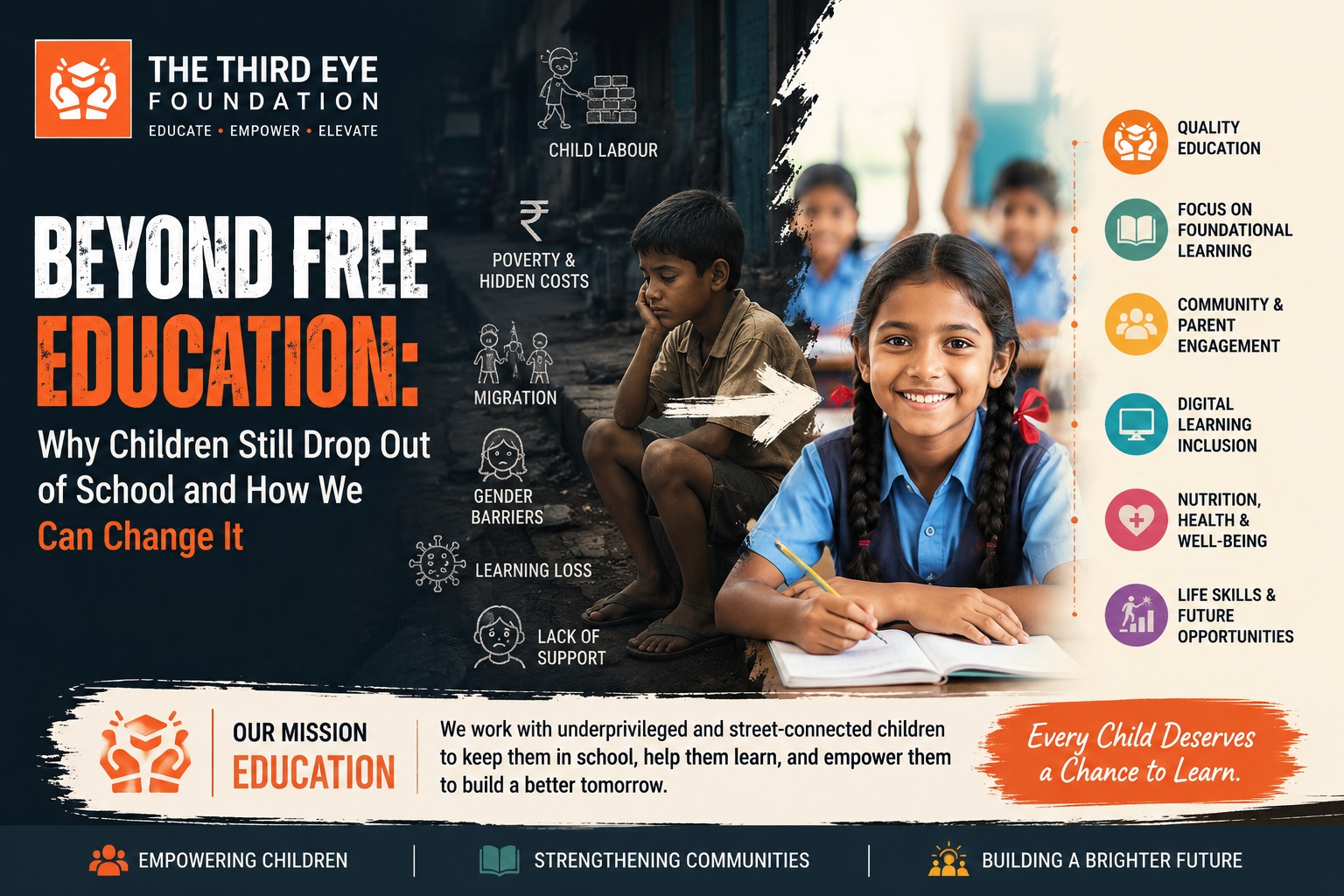

Education is often described as the most powerful tool for breaking the cycle of poverty. Over the years, governments across the world, including India, have introduced free and compulsory education policies to ensure that every child has the opportunity to learn and build a brighter future. Yet, despite these efforts, millions of children continue to leave school before completing their education.
This raises an important question: if education is available free of cost, why are so many children still dropping out?
The reality is that the challenge extends far beyond school fees. For children from vulnerable communities, particularly street children and those living in poverty, education is affected by a complex web of social, economic, and personal challenges. Lack of financial stability, family responsibilities, migration, child labour, poor health, inadequate learning support, and social discrimination often prevent children from staying in school.
At The Third Eye Foundation, we believe that solving the dropout crisis requires addressing the entire ecosystem around a child, not just providing access to a classroom.
Understanding India's School Dropout Challenge
India has made remarkable progress in expanding access to education over the last two decades. Initiatives such as the Right to Education (RTE) Act, midday meal programmes, free textbooks, and scholarship schemes have helped millions of children enrol in schools.
However, enrolment alone does not guarantee educational success.
While primary school retention rates have improved significantly, student retention declines sharply as children move into higher grades. Many students who begin their educational journey never complete secondary or higher secondary education.
The challenge is particularly severe among children from low-income households, migrant families, urban slums, and rural communities. Street-connected children face even greater risks due to unstable living conditions and limited access to continuous learning opportunities.
Every child who leaves school represents more than a statistic - it represents a lost opportunity for personal growth, economic independence, and social mobility.
Poverty: The Invisible Cost of "Free" Education
One of the biggest misconceptions about free education is that it completely removes financial barriers.
Although tuition fees may be waived, families often continue to bear numerous indirect educational expenses. These include :
For families struggling to meet daily needs such as food, rent, and healthcare, these additional costs can become overwhelming.
As a result, many children are forced to contribute to household income instead of attending school. Some work in agriculture, construction, roadside businesses, domestic labour, waste collection, or informal employment sectors.
For street children, the situation is often even more challenging. Survival becomes the immediate priority, leaving little room for consistent education. Without targeted support, many of these children become trapped in a cycle of poverty that can continue across generations.
Child Labour and Education: A Difficult Reality
Child labour remains closely linked to school dropout rates.
When families experience economic hardship, children are often expected to help support household income. While some may balance work and school initially, many eventually leave education altogether due to exhaustion, irregular attendance, or academic struggles.
Children engaged in labour frequently miss critical learning milestones, making it difficult to keep pace with their classmates. Over time, frustration and reduced confidence lead many to disengage from education completely.
Breaking this cycle requires not only educational support but also community awareness, family counselling, and economic empowerment initiatives that reduce dependence on child labour.
The Lasting Impact of the Pandemic
The COVID-19 pandemic exposed deep inequalities within education systems across the world.
School closures disrupted learning for millions of students. While some children transitioned to online education, many others lacked access to smartphones, computers, internet connectivity, or a suitable learning environment at home.
Children from economically weaker backgrounds were among the most affected. Many experienced significant learning loss, and some never returned to school after classrooms reopened.
The pandemic also highlighted the digital divide that continues to affect educational opportunities today. Students without access to technology face disadvantages that can widen learning gaps and increase dropout risks.
For vulnerable children, especially those living on the streets or in informal settlements, educational disruptions often resulted in long-term disengagement from learning.
Why Secondary Education Sees the Highest Dropout Rates
The transition from primary to secondary education remains one of the most critical points where students leave school.
As children grow older, they face increasing pressures from family responsibilities, social expectations, and economic realities. Several factors contribute to secondary-level dropouts:
Many students begin questioning the value of education when immediate financial needs seem more urgent than long-term academic goals. Without guidance and support, they may choose employment over continued learning.
Challenges Faced by Girls in Education
Although significant progress has been made in improving girls' enrolment rates, many continue to face barriers that threaten their educational journey.
Common reasons girls leave school include:
In many communities, boys' education continues to receive greater priority when resources are limited. As a result, girls are often the first to discontinue their studies.
Ensuring equal educational opportunities for girls requires community engagement, awareness programmes, safe learning environments, and sustained support systems.
Street Children: The Most Vulnerable Learners
Among all groups affected by educational exclusion, street children remain one of the most vulnerable.
Many lack stable housing, regular nutrition, healthcare access, parental support, or documentation required for school admission. Frequent movement, unsafe environments, and social stigma further increase their risk of dropping out.
Yet these children possess extraordinary resilience and potential.
When provided with access to education, mentorship, emotional support, and a safe learning environment, street children can overcome immense challenges and build successful futures.
This is why targeted educational interventions are essential. Every child deserves the opportunity to learn, regardless of their circumstances.
How The Third Eye Foundation Is Creating Change
At The Third Eye Foundation, education is one of our core missions because we believe it is the most sustainable path toward long-term social transformation.
Through our Mission Education initiative, we work directly with underprivileged and street-connected children to ensure they remain engaged in learning and are empowered to achieve their full potential.
Our efforts focus on:
Foundational Learning Support : Helping children strengthen literacy, numeracy, and core academic skills through remedial education programmes.
Community-Based Education : Taking learning closer to underserved communities where access to quality educational support remains limited.
School Retention Initiatives : Identifying children at risk of dropping out and providing guidance, mentoring, and continuous academic support.
Parent and Community Engagement : Working with families and local stakeholders to emphasise the importance of education and encourage regular school attendance.
Digital Learning Inclusion : Supporting children with access to learning resources that help bridge the digital divide.
Holistic Child Development : Recognising that education is interconnected with nutrition, health, emotional well-being, and life skills.
Our goal is not simply to enrol children in schools but to ensure they remain in education, succeed academically, and develop the confidence needed to create better futures for themselves.
Looking Beyond Enrolment Numbers
Educational progress should not be measured solely by the number of children entering schools. True success lies in ensuring that children stay in school, learn effectively, and transition into productive adulthood.
Reducing dropout rates requires a comprehensive approach that addresses both educational and social challenges. Children need more than a classroom - they need supportive families, safe environments, adequate nutrition, emotional well-being, quality teaching, and opportunities for future growth.
When a child leaves school prematurely, society loses valuable human potential. Conversely, when a child remains in education, entire communities benefit through improved health, stronger economies, and greater social equality.
Education must go beyond access. It must become a pathway that enables every child, including the most vulnerable and marginalised, to learn, grow, and thrive.
Together, we can ensure that no child is forced to abandon their dreams because of circumstances beyond their control.