
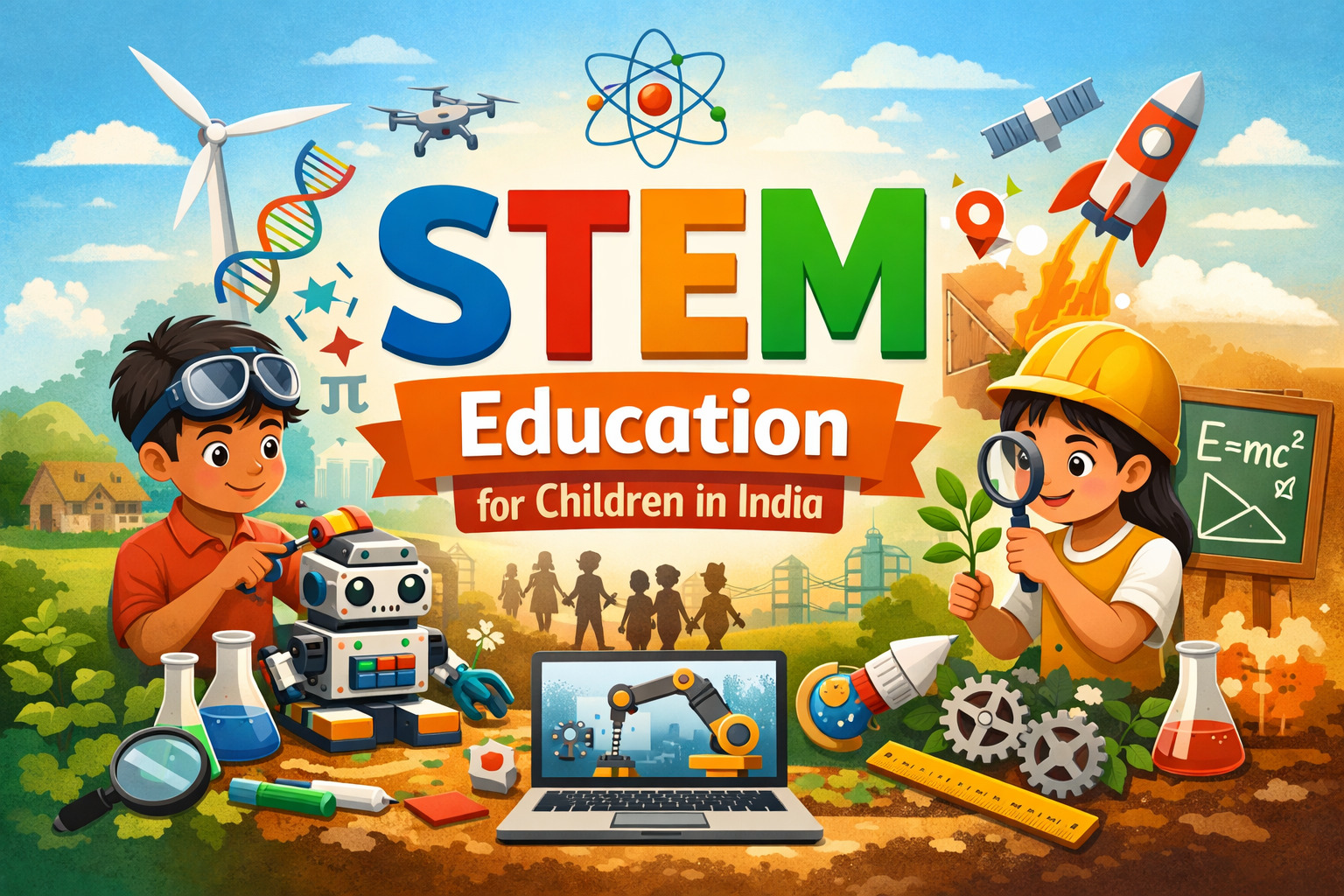

In today’s fast-evolving world driven by technology and innovation, building a strong foundation in STEM education has become essential. STEM—an integrated approach to Science, Technology, Engineering, and Mathematics — goes far beyond rote learning or memorising formulas. It equips children with critical thinking, creativity, collaboration, and real-world problem-solving skills that are crucial for success in the modern era.
Imagine learning environments where students are not passive listeners but active creators—building simple robots, designing sustainable homes, experimenting with scientific concepts, and solving real-life challenges. STEM education nurtures curiosity and innovation, empowering children to adapt, think independently, and thrive in a constantly changing global landscape.
Let us explore what STEM education truly means, why it is important for young learners in India, and how The Third Eye Foundation is helping children in rural communities gain access to quality STEM learning.
Understanding STEM Education
STEM education is a holistic and interdisciplinary learning approach that blends science, technology, engineering, and mathematics into practical, meaningful experiences. Rather than treating these subjects in isolation, STEM encourages students to apply knowledge across disciplines to solve real-world problems.
For instance, a classroom project might involve studying water pollution (science), analysing data using digital tools (technology), designing a basic filtration system (engineering), and measuring environmental impact using calculations (mathematics). Such experiences help students connect theory with practice and understand how different fields work together.
Hands-on activities like robotics workshops, science experiments, and design challenges play a key role in STEM education. These experiences strengthen analytical thinking, teamwork, and innovation, while also building confidence in applying concepts practically.
Beyond academics, STEM education prepares children for future careers by cultivating a mindset of inquiry, adaptability, and continuous learning—qualities essential for driving scientific progress and social development.
The Current State of STEM Education in India
India has made notable efforts to promote STEM education through policy reforms and curriculum changes. The National Education Policy (NEP) 2020 emphasises experiential learning, critical thinking, and skill-based education, encouraging students to move beyond memorisation and become problem solvers.
However, despite these initiatives, several challenges remain. Many schools—especially in rural and underserved areas—lack adequate infrastructure such as functional computer labs, internet access, and modern teaching tools. Additionally, a shortage of trained STEM educators and outdated teaching methods continue to limit the effective implementation of STEM programs.
These gaps highlight the urgent need for stronger support systems, better teacher training, and increased access to resources to ensure that STEM education reaches every child, regardless of location or background.
Key Benefits of STEM Education for Children
STEM education offers far-reaching benefits that extend beyond academic success. It helps children develop essential life skills that prepare them for both professional and personal challenges.
1. Cognitive Development
Through experiments, design projects, and problem-solving activities, children sharpen their logical reasoning, analytical thinking, and decision-making abilities. Tasks like building circuits or creating simple models encourage independent thinking and creativity.
2. Improved Academic Performance
The interdisciplinary nature of STEM helps students form deeper connections between subjects. When children see how mathematics supports science or how technology enhances learning, they gain a stronger conceptual understanding, leading to better academic outcomes.
3. Career Readiness
Early exposure to STEM enables children to explore interests that may shape future career paths. Fields such as artificial intelligence, renewable energy, biotechnology, robotics, and data science offer vast opportunities for students equipped with STEM skills.
Role of STEM in Developing Essential Life Skills
STEM education plays a crucial role in building transferable skills that are valuable across all areas of life. Collaborative projects teach children teamwork, communication, and leadership. Innovation-driven tasks encourage creativity and experimentation, while trial-and-error learning builds resilience and perseverance.
When students learn that failure is part of the learning process, they develop confidence and adaptability—qualities that are vital in both education and real-world problem-solving.
Challenges in Implementing STEM Education in India
Despite its importance, implementing STEM education in India comes with several obstacles:
1. Curriculum Gaps
Many schools struggle to keep curricula updated with evolving STEM advancements. There is often an imbalance between theoretical knowledge and practical application.
2. Teacher Training
A lack of well-trained STEM educators, particularly in rural areas, limits effective teaching. Continuous professional development and exposure to modern teaching methodologies are essential.
3. Infrastructure Limitations
Insufficient access to laboratories, computers, digital tools, and reliable internet connectivity restricts hands-on learning experiences.
4. Socio-Economic Barriers
Children from underprivileged backgrounds often lack access to quality STEM education. Gender stereotypes and financial constraints further discourage participation, especially among girls.
How The Third Eye Foundation Supports Access to Education
The Third Eye Foundation works tirelessly to ensure that every child, regardless of socio-economic status, has access to quality education. With a strong focus on rural and marginalised communities, the foundation addresses barriers that prevent children from learning.
Through community engagement, awareness programs, and partnerships with parents and educators, the foundation identifies out-of-school children and supports their enrollment and retention. Academic support centres provide guidance, learning assistance, and continuity in education.
Beyond access, the foundation advocates for policy implementation and ensures children receive essential resources such as textbooks, mid-day meals, and learning materials—creating a supportive ecosystem for holistic development.
Conclusion
The importance of STEM education for children in India cannot be overstated. It equips young learners with the skills needed to navigate a technology-driven world while fostering innovation, critical thinking, and social responsibility. By investing in STEM education today, we are empowering the next generation to contribute meaningfully to India’s progress and global development.
Frequently Asked Questions About STEM Education
What is the aim of STEM education?
The primary aim of STEM education is to develop critical thinking, analytical reasoning, and problem-solving skills through an integrated learning approach, preparing students to address real-world challenges.
How does STEM education prepare children for future careers?
STEM education builds creativity, collaboration, and technical proficiency through experiential learning, making children well-prepared for careers in technology, healthcare, engineering, research, and beyond.
What role do NGOs play in STEM education?
NGOs bridge educational gaps by providing resources, training, and learning opportunities to underserved communities. They promote equal access to STEM education and inspire children to pursue science and technology-driven futures.